
Riviera Radio, the long-standing English-language radio station based in Monaco and serving the French Riviera, was acquired a few months ago by London-based Capital—or rather, by Global. The group has revamped the studios and the station’s image and launched a major traditional promotional campaign; however, they also added a completely false historical claim to the station’s website: that the station was an initiative of Grace Kelly.
We therefore asked Grant Benson and Kevin Turner—former Radio Caroline DJs and the station’s co-founders—to tell us the real story. It is a tale that will undoubtedly appeal to those nostalgic for the heroic era of pirate radio.
The disputed statement
Here is the statement in question, found at this link:

Princess Grace
Let us start by noting that Princess Grace did play a role in Monegasque broadcasting: she personally switched on the first VHF TV transmitter for Tele Monte-Carlo in the 1950s. However, there is no evidence that she played any part in the story of Riviera Radio.
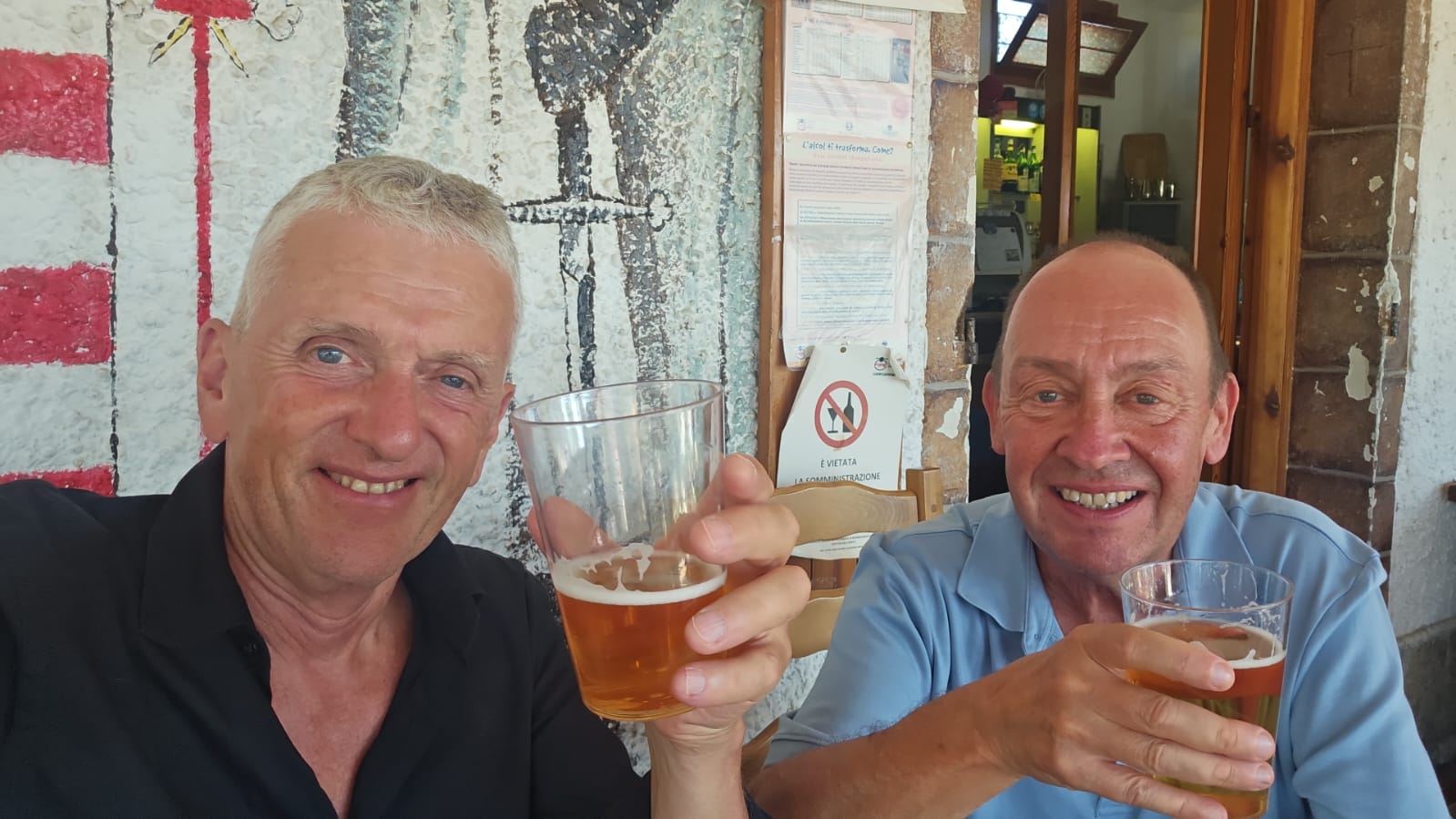
Grant & Kevin, 2026
Sovereign
Here, then, is the full story of Riviera Radio, as told by Grant and Kevin.
From Radio Sovereign to Riviera Radio
An interview with Grant Benson and Kevin Turner
Introduction
Grant Benson: I’m Grant Benson, and we’re here with my mate Kevin Turner, talking about the early days of Radio Sovereign on the Côte d’Azur and its metamorphosis into Riviera Radio. The reason I’m getting Kevin involved is that his memory is far superior to mine, and I think he was probably more instrumental in the whole project than I was.
Now, you were working Radio Sovereign — we’ll call it a pirate station — in London with John Kenning. That was very successful. For how long?
Kevin Turner: It came on air in the spring of ’83, and it finished—
Grant Benson: Kevin, just turn your microphone over a bit.
Kevin Turner: Oh, it’s fallen over.
Grant Benson: It’s fallen over, yeah. Let’s try the — use the magnet, slide it off — there you go. That’ll get us a better signal from you.
Kevin Turner: Yeah, pick it up here.
Grant Benson: So, it was on air for what, a couple of years?
Kevin Turner: Less than a year, actually. Spring ’83, and it ended on the 2nd of January 1984 — I actually did the last programme. John had already heard about English radio on the Côte d’Azur broadcasting from Italy, and so he made an exploratory trip down.
The Trip That Started It All
Grant Benson: Was that the one with me?
Kevin Turner: That one was with Kevin — yeah, yeah, yeah.
Grant Benson: Which I think was before Sovereign Twickenham had closed.
Kevin Turner: You’re right, because I remember we came down — we were talking about this the other day — we came down in his mini, had a great week. I totally sold him on the idea of Riviera radio, which obviously isn’t difficult. He saw the shambles that Radio Nova had become, the previous English-language station down there, and he saw that there was a perceived market. We came back, and he offered me a gig on Radio Sovereign in London. So, thinking back on it… yeah, Sovereign—
Grant Benson: Sorry, we digressed a fraction there. You’d sold him the idea, I take it, and he then proceeded to wind up Sovereign London?
Kevin Turner: Sovereign Twickenham basically had to close, because the way the system worked back then — even though the station had no licence — was that they’d raid you, visit you, take various measurements and notes, then go away and build a case for prosecution. That took about six months. John had already been to court once, paid a fine of a few hundred pounds, got a slap on the wrist, and literally went straight back and switched it all on again — just a few hours off air.
What happened on the second court case, and what made John decide he couldn’t carry on in London, was that the judge ordered the transmission equipment to be confiscated. But the real clincher for John was that his very extensive and valuable record collection would have been seized as well. He just wasn’t prepared to let that happen. So, as you say, the idea of doing radio on the Côte d’Azur had already been planted in his mind, and what we really did was pack up the entire radio station into a container and ship it down to Italy.
Setting Up in Italy
I was sent down as the pathfinder, if you like. I secured some property in Vallecrosia, and I think we’d done a deal on a transmitter site close to Bordighera — again, very near the French Riviera. I bought a transmitter in Milan. I didn’t even know how to spell “transmitter,” let alone what I was looking for, but I had a wad of cash in my back pocket, went up to Milan, bought one, and came back down. We had a local fixer, a guy called Oscar Porfirio, who helped us with a lot of the local logistics on the ground.
What always strikes me a little is the youthful naivety of it all. We really didn’t know what we were doing — or at least I speak for myself. The incident that reminds me of that is when we came to put the aerial mast up.
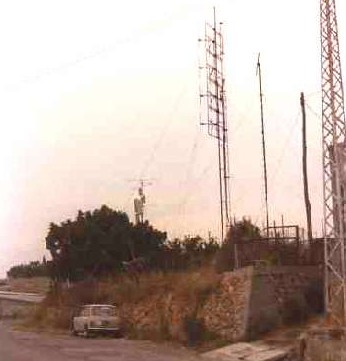
Building the Mast
We got a couple of locals from the village we were living in, Seborga, to dig the hole. It was meant to be a metre wide, a metre the other way, and a metre deep. Instead, the digger was very enthusiastic at the start, so it ended up wider at the top than at the bottom.
Grant Benson: A reverse pyramid.
Kevin Turner: Yes, exactly, a reverse pyramid. So when we came to fill it with concrete, we didn’t have enough — we’d have had enough if it had been the right dimensions, but because of this odd shape it was actually a bigger hole than it should have been. I remember chucking in boulders, old tree trunks, anything at all, just to flesh it out. But we got there. We put the concrete base down and, as instructed, set four bolts sticking upward through it at each corner.
When the mast eventually arrived from the UK — a versatile, wind-up job from a mate of mine, Ian Marshall, and a very good mast it was too — sadly, it had got bent in transit. I’ll come back to that. Anyway, we popped the base on, did up the nuts, and it seemed to work. We gave quite a creditable impression of people who knew what they were doing.
Then we had to attach three dipoles to the top of the mast. They came from a UK company called J-Beam, who very handily supplied a little instruction sheet.
Grant Benson: Instructions — I think that’s what they’re called.
Kevin Turner: I think you may be right. And we did stick to them — it said the dipoles had to be spaced exactly such-and-such a distance apart, and the cables attached in a certain way. We did all that. But neither of us had put up an aerial like that before — we weren’t engineers.
The Transmitter Arrives
So it was all sitting there ready to go. And, as you say, the transmitter came down from Milan — you’d actually bought a very good one, even if you didn’t know it at the time.
Grant Benson: I’d done good. I think I chose it by the pictures.
Kevin Turner: The two big suppliers in Italy at the time were Etelco and Elpro. We went with Elpro — I think they gave me sandwiches when I got there.
Grant Benson: It’s easy to buy meat!
Kevin Turner: It came down on the back of a truck, completely exposed to the elements — I remember that. They didn’t seem too worried; I suppose their attitude was, it’s Italy, it’s summer, it doesn’t rain. Anyway, they arrived and connected it all up. I remember thinking, well, I hope this works, because if you get an aerial wrong and put high power through it, it goes bang — and you’ve done a lot of damage.
The engineer from Elpro seemed relatively happy with what we’d done. He connected it all up through the switch, and the meter went well over two kilowatts. Then he checked the reflected power coming back down and said, “Oh yes, this is a very good aerial — I’m quite happy with this.” And off he went.
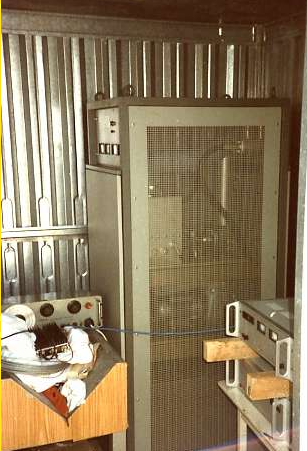
Even though the site at Bordighera Alta wasn’t as high as Seborga, where Radio Nova broadcast from — Seborga’s about 500 metres above sea level, Bordighera Alta was probably less than a couple of hundred — because it sat on a little cape, a peninsula sticking out, it did very well.
The Frequency
Grant Benson: We got 104.1, which was debatable whether it was in or out of the permitted band at the time, wasn’t it?
Kevin Turner: It was — the band was supposed to finish at 104, but there were some Italian stations nudging up to 104.5 or so. And I do remember we had to go and do a bit of negotiating over the frequency with Radio San Remo. When we looked into it, at that time you registered your frequency rather than being given a licence for it. When we did the research, we discovered that even though 104.1 seemed clear along Bordighera and the Côte d’Azur, Radio San Remo had registered that frequency somewhere the other side of San Remo.
So we went over and had a quick chat with them, and they turned out to be very reasonable people. I remember sitting down with a chap called Cremieux, who I believe was the owner of Radio San Remo — or maybe one of the Stereo Torelli people, I’m not entirely sure. But anyway, we told them what we planned to do and said we didn’t think we’d cause any interference, since our beam pointed in the opposite direction, and Bordighera itself was hidden from their transmission area by another headland. They said, fine, go for it — and if it does cause interference, we’ll let you know.
Going On Air
Grant Benson: I think when you actually switched the whole thing on, I’d already come back to the UK and gone back to Radio Caroline. I don’t think I was around at that point — correct me if I’m wrong.
Kevin Turner: I think you’re right, yeah.
Grant Benson: What was the signal like? You switched it on — I’m sure, being the anoraks that we are, the first thing you did was go down the coast and listen to it.
Kevin Turner: Absolutely right. We didn’t have the studio link ready yet from Vallecrosia up to Bordighera, so we put out a simple test tone — tones travel and modulate better than music for testing purposes. We jumped in John Kenning’s Mini and drove down the coast, and he kept saying, “This is incredible, this is incredible.” We went through Monaco, through Monte Carlo, got as far as Antibes, and past Antibes — and the signal still wasn’t a problem at all. We spent the afternoon checking it out as far as we could get.
Grant Benson: Did it get into Nice?
Kevin Turner: It got into Nice better than Radio Nova had. It still didn’t get deep into the city, but it covered the coastal parts and quite a way in — nearly to the centre of Nice, I’d say, but certainly no further than that. The signal was pretty good there — certainly better than Nova had managed. So we turned around and came back.
Establishing the Studio Link
A guy called Dave Bowen came down shortly after with the equipment for the studio link.
Grant Benson: I think I was around for that, because we had to run a cable from the studio to the block of flats behind it, where the uplink transmitter went. I remember being around for that bit — I can’t remember who climbed onto the roof of that building. Was it you, or me?
Kevin Turner: It certainly wasn’t me — I don’t do heights. And I don’t think it was Dave either. I think we might have persuaded somebody local.
Grant Benson: Somebody local, braver than us.
Kevin Turner: Anyway, they went up, and we established the link between the studio and the transmitter. Everything seemed to be going quite well. We came on air at 6 in the morning, which we later extended to 5, and finished around midnight or 1am.
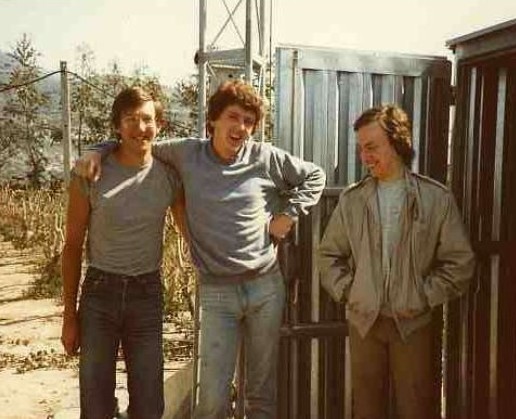
Grant, Kevin and a BBC Engineer, 1984 (?)
The On-Air Staff
Grant Benson: Let’s run through the on-air staff, then.
Kevin Turner: Right. To start with, I did breakfast, 6 till 10 — I think the slots were all four hours. Then it was Mark Dezzani, who’d previously been on Radio Nova.
Grant Benson: Nova shut down literally a day or two before we came on air.
Kevin Turner: So he was available. John Kenning did the afternoon — he was the owner, obviously. And we’d had another guy come down with us, Mike Mendoza.
Grant Benson: Oh, he was great. I was still in touch with Mike — he went on to do LBC in the UK, did quite well for himself. Talk radio.
Kevin Turner: He didn’t stay around very long, but he was certainly there in the early days. I think he’s a politician in the UK now.
Grant Benson: That’s interesting — I could see Mike doing that.
Kevin Turner: And then the late show, I think, was Stuart Clarke.
Grant Benson: That would figure — he’s now quite a big journalist in the Irish press. Hot Press, I think, is who he worked for.
Kevin Turner: So we had about 20 hours or so of broadcasting a day.
Trouble With the State Broadcaster
Then there was a knock on the door about three weeks after we’d started, and it was a man from RAI, the state broadcaster. Very pleasant, but he told us we were causing them problems up the valley — that was the link transmitter. It was a Band III transmitter, and back in the UK, VHF television had long since ceased to exist, so we’d rather naively assumed the frequency was clear in Italy too. We had no idea.
Grant Benson: It could have been the police as far as we knew.
Kevin Turner: It didn’t wipe out RAI Tre — it wiped the colour off RAI Tre, because we were right on the edge of the frequency. He came in and basically said we’d have to shift and stop straight away. Obviously that was a huge blow.
Grant Benson: So the station went off air for a while?
Kevin Turner: Not for much more than a day or so — lots of frantic phone calls. We found a small FM transmitter in San Remo; I think it may even have been Radio San Remo who helped us with it. We set up a new link from the studio up to Bordighera on 107-point-something. It wasn’t perfect, but it kept us on air for a few weeks, until Dave Bowen came back down with a new crystal for the link transmitter.
We moved off Band III, which in the UK was ITV’s VHF band, onto Band I, which was BBC’s — and which was actually still used in that part of Italy for some of RAI Uno’s broadcasting. It was a very mountainous region, and until the advent of digital terrestrial broadcasting, RAI Uno stayed on VHF because it was considered the backbone of communications: when everything else failed, you still had a strong VHF signal throughout the country. This time we’d done our research and made sure we weren’t sitting on top of RAI Uno.
Money Troubles
So the station was up and running. We were all a bit naive about what we were doing — John, and the rest of us, were all involved to some degree in selling airtime, but it was always a struggle.
Grant Benson: So how long did the station run before John decided he had to get out?
Kevin Turner: We came on air just after Easter 1984 and ran through the summer. The summer was relatively okay, because the Côte d’Azur is full of tourists and fairly busy, and John was a good salesman — he went up and down selling adverts to restaurants, bars, and a few shops here and there. We’d given him a list of old radio advertisers, and he managed to reel a few of those in.
But when winter came, things got really tight financially. In all fairness to John, the wages were always paid, but I know he and his partner Gilly had to move out of their flat in San Remo because they couldn’t afford it, and found some temporary accommodation — I think a holiday chalet or something near Ventimiglia. I heard some pretty horrific stories about dinner out of a tin of sardines, or jumping the fence to the farm next door to help themselves to eggs and spinach. Things did get a bit rough for him.
Then we hit a bit of luck. John found an old Radio Nova salesman we used to know as Cross-Eyed Tony — he was also my mechanic for a while. Tony was a very good salesman; I never quite understood how, but he was. He brought in some more clients and a bit more money. We got through Christmas and into the New Year, but springtime didn’t really bring the upturn in tourism and business that John had hoped for.
The Australian Buyout
But as luck would have it, an Australian businessman had checked into a hotel in Monte Carlo, discovered Radio Sovereign, and had been listening to it.
Grant Benson: This is the interesting part. What was this guy’s name?
Kevin Turner: I think it was Steve Cosser — going on my very fractured memory here. He was involved with a swimwear company in Australia.
Grant Benson: Yes — I believe the company was called Lintel, or something like that.
Kevin Turner: But they had media interests as well, so he was partly wearing that hat. He’d listened to Sovereign and quite liked the output — by that stage it had settled down and was pretty good. He got in touch with John and said he’d like to meet. John went over to the hotel in Monte Carlo, and basically the guy said, “I’ve been in touch with my business partners back in Australia, and we’d like to buy your radio station.” The figure they were talking about was quite substantial.
Grant Benson: Go on, out with the numbers.
Kevin Turner: It was pretty much a million pounds.
Grant Benson: A million quid — that’s a hell of a sum. We’re talking 40 years ago; a million pounds was an awful lot of money in those days, let alone today.
Kevin Turner: I think to John it was absolute manna from heaven — from having to nick produce off the local farm to having someone offer you a million pounds in cash, in a suitcase, in a Monagasque hotel. Quite a leap. He didn’t hand over the money straight away — he said, “If we can agree terms, I’ll go back to Australia, finalise the deal with my partners, and then come back.” And within about six weeks or so he was back with a suitcase full of money — or at least, that’s what John was handed in a hotel room in Monte Carlo.
They didn’t buy him out completely at that stage — I think John kept 25%.
Grant Benson: Was that to keep him involved?
Kevin Turner: I’m not sure. I think John just didn’t want to relinquish it entirely, but he’d realised the deal was too good to turn down. So he ended up with something like three-quarters of a million pounds, and he and Gilly went back to the UK.
I’d also been on the Côte d’Azur by that stage for about three years, and I thought, right, I need to go back to the UK and see if I can get into UK radio properly. So I went back — although a couple of months later, the Australians brought in a very experienced chap called Aidan Day, who’d been involved with Capital Radio in London, along with his partner Roger Manning. Aidan tracked me down, and I went to see him at his place in Kensington, about the idea of me going back. I was tempted, but I decided I really wanted to see if I could make it in the UK.
Riviera Radio Is Born
At that point the Australians were still only 75% owners, but that gave them complete effective control. They brought in a guy called Andy Gemmell-Smith, well known in the UK for his work as a radio engineer — he’d done offshore radio transmitter engineering and built up a very successful studio business called Alice SoundTech. Andy came down and changed the aerial system at Bordighera, and with a great flurry of publicity, the Australians rebranded the station as Riviera Radio — while it was still based in Italy.
Within a year or so, they bought out John’s remaining 25%. They called him up and said they wanted complete control; after negotiation, I believe he got his £250,000 plus a bit more on top as a sweetener. From that point they were in complete control.
The negotiations with Monaco to move the station over there began soon after. They did a deal for some premises down by the port — very close to, if not within, the same building as Radio Monte Carlo. There’s a whole row of buildings along there — some ship chandlers, and it runs down to where the yacht club used to be, with the Rascasse at one end and Stars ‘n’ Bars at the other. I think it’s gone now, I’m not sure, but it was practically in the same building.
From that point, that’s basically the story of how Riviera Radio was born.
Ownership Changes Over the Years
Grant Benson: As we know, Riviera Radio went through a number of ownership changes after that. The Australians eventually sold out to Capital Radio — I think the Barclay brothers were involved, and there was a Swedish group in there too, if I’m not mistaken. Macquarie were involved at some stage as well.
Kevin Turner: Macquarie — that’s Australian again, isn’t it? A very big Australian industrial group.
Grant Benson: Then, of course, there was the American group that had it fairly recently — they hold a number of broadcast interests, a minor one in the States. Right through to the current situation, where it’s part of Global.
Kevin Turner: Or effectively Capital again.
Grant Benson: Exactly — the whole thing’s come full circle. I remember there was a time when Chris Tarrant from Capital Radio broadcast his programme from Monaco, from the Riviera Radio studio, for one summer. For a while the sound on air was just like Capital’s — they’d taken the same jingles and re-sung or re-voiced them.
Kevin Turner: Which is exactly what’s happened now with Heart and Global.
Grant Benson: For a while they were still broadcasting from Italy — they got the studio base in Monte Carlo fairly quickly but had to link back to Bordighera. The intention, and eventually what happened, was that they put a transmitter on Mont Agel — the big 106.5 they use now — and a smaller one, 106.3, in the Jardin Exotique. Up on Mont Agel the signal actually tends to fly straight over Monaco rather than into it, but they’ve still got very good coverage.
Kevin Turner: Radio Nova and Radio Sovereign, we always used to say, went from San Remo to Saint-Tropez — but it never really got into the big metropolis, Monaco.
Grant Benson: No. One thing we did do with Sovereign, in spite of people being surprised about it, was that fairly swiftly, within the first couple of weeks, we switched to mono. We discovered mono travelled better.
Kevin Turner: Lots of stations have done that. If you put a pilot tone on, the stereo light comes up on people’s car radios — but that light coming on was never the priority.
Closing
Grant Benson: Kev, thanks for that. I tell you, one of these days we’ll have to get some other people involved in this as well, because there’s also the Radio 108 chapter, which I was involved in, and Sunshine Radio, which Mark Dezzani was involved in too. Is there anybody else I’m missing?
Kevin Turner: There was Coast, the religious station.
Grant Benson: Yes — they became great friends, and very helpful too. It wasn’t as if we were competing; we all helped each other out. The devil and the deep blue sea, at the end of it all.
Kev, great — thanks for that.
Kevin Turner: You’re welcome. Talk to you again soon.